Showing posts with label London developer meetup third testing selenium interfaces person accounts b2c schema spy builder. Show all posts

Saturday, 27 September 2014

London Salesforce Developers September Meetup

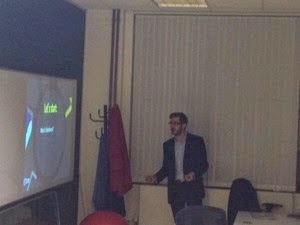
The September gathering of the London Salesforce Developers took place on September 24th at the Make Positive offices on the south side of the River Thames.  The talk this month was a continuation of the previous month’s integration theme on Multi Org Collaborative Architecture, by Richard Clark.

IMG 1468

I’m not going to give too much away about this talk, as it was a dry run for Dreamforce. If you aren’t going to Dreamforce you’ll be able to view the slide deck and probably a recording of the talk as most dev zone sessions are recorded.

What I will say is that there is some good, generic single versus multi-org content which anyone considering the two strategies will find useful, followed by a deeper dive into the challenges and solutions around cross-org collaboration.

As usual this was followed by a trip to a local hostelry for some further discussion and networking (and the usual delays on my train home, as my twitter followers know only too well!).

The inaugural meetup of the London Salesforce Admins takes place on Thursday October 2nd - I’m attending this so stay tuned for a write up after the event.

Sunday, 31 August 2014

London Salesforce Developers August Meetup

The August meetup of the London Salesforce Developers took place on Wednesday 27th, kindly sponsored by Make Positive.

This month our main organiser, Anup Jadhav, stepped away from the organisational side of the group and into the spotlight to present a talk on integration - building a messaging framework based on the Message Queue concept: 

Anup meetup

This is clearly a topic that a lot of people are interested in - the talk took in excess of 50 minutes and generated more questions than any talk I can remember. As this was a dry run of Anup’s Dreamforce talk, the slide deck won’t be available until after Dreamforce, although the good news is that isn’t that far away now.

If you are a Salesforce Developer in the London area and you aren’t attending these meetups, you should join us.  Its a great way to spend an evening - you’ll eat some pizza, drink some beer and learn something - what’s not to like.

If you are a Salesforce Admin in the London area, you should join the new London Salesforce Admins meetup group, organised by Matt Morris

In fact, if you are a Salesforce Admin or Developer in the London area, you should join both.  There’s plenty that everyone can learn from each other, and developers/admins will get closer at Dreamforce with the new Admin Zone in the heart of the Dev Zone at Moscone West. 


Monday, 21 April 2014

London Calling - Salesforce1 Developer Week

Keep calm it s gonna be totally awesome 54

Salesforce1 Developer Week is series of events taking place around the world between 27th April and 3rd May 2014. The London Salesforce Developer Group are hosting an event on 30th April from 5:30pm:

Screen Shot 2014 04 19 at 17 06 21

Right Side of the Tracks

In a groundbreaking move, we’ll be running two tracks for this event, both with a hands-on focus:

  • Beginner Track
    If you’ve never developed against the Salesforce1 platform before, attend beginner track. This covers the basics of creating an application via drag and drop; adding process automation, all without writing a single line of code.
    Having run a few “Introduction to Force.com” workshops, the most common feedback from attendees is they are amazed how quickly you can build applications when most of the heavy lifting is done by the platform.

  • Intermediate Track
    The intermediate track will introduce use of Visualforce in Salesforce1, among other items. This is the track for the “clicks not code” developer who is interested in taking the next step, as well as experienced developers from outside the Salesforce ecosystem who have covered the basics through attending an introductory workshop or completed the Force.com Workbook. Experienced developers should prepare themselves to write much less code than they are used to when creating custom applications – in Salesforce1 code is written to extend the existing platform functionality rather than building from the ground up.

Salesforce1 Team, Assemble

We’ve put a crack team of presenters and helpers for this event, including MVPs and a couple of Salesforce Certified Technical Architects, so regardless of your level of experience with Force.com (if any) there will be someone on hand who can help if you get stuck. This also gives rise to some excellent networking opportunities during and after the event.

There’s no Such Thing as a Free Lunch

But there is such a thing as a free event - all you need to bring is yourself and your laptop. There are also exclusive event T-shirts (while stocks last) and Salesforce1 books (again while stocks last). 

Its Five O’Clock Somewhere

Its actually 5:30 at Tquila HQ - its an early start to allow as much development time as possible.  Register for this event here. I look forward to seeing you.

Update 25/04/2013: the time has been moved to 6pm.

Friday, 28 March 2014

London SFDG March Meetup

On 26th March the London Salesforce Developer Group once again congregated at Make Positive’s offices just south of the River Thames for our monthly meetup. It was great to see a few new faces who had tried Salesforce at the Elevate London Workshop and had come back for more.

Over the last couple of months we’ve moved to themed events, where all talks relate to a specific topic.  February’s theme was Salesforce1, and March built on the knowledge gained there and covered Mobile Access to APIs.

Laurent Delcambre of Tquila was on first, talking about extending Salesforce1 functionality through the analytics API to bring in reporting functionality.

Ld


Next Alessio Valentini, also of Tquila, gave a talk on developing a mobile application where the functionality lives on-device and all Salesforce data is accessed via APIs.

Av

We had a great turnout again this month - the meetup really seems to have taken off this year.

Ldsize

Beer, pizza and networking filled the time before the talks, while beer and networking continued on later into the night, moving to a local hostelry once we’d emptied the Make Positive fridge.

If you are based in or around London, work with or are interested in Salesforce, and aren’t a member of this group you should join - just signup at http://www.meetup.com/LondonSalesforceDevelopers/

The next meetup takes place towards the end of April - I hope to see you there.

One more thing - we also have a new hashtag - #LonDevSFDC - search us on twitter for news and updates about the group.

Friday, 24 January 2014

London Salesforce Developers January Meetup

After a December break, the London Salesforce Developers returned with a vengeance in January.  Around 50 attendees descended on Make Positive’s offices for pizza, beer and talks on Salesforce security. We also had a couple of newly minted MVPs visiting - Chris Lewis and Phil Walton - and I’m sure a few people took the opportunity to find out more about how they’d managed to achieve this accolade.

First up was Wes Nolte on Sharing Rules - the unsung hero of Salesforce security.  

IMG 1092

Sharing is an extremely important topic, especially for consultants who are expected to understand all of the possible sharing options, be comfortable explaining these to clients and recommending the most appropriate option for a client implementation. Sharing also comes up in all certification exams from Administrator through to Technical Architect, where candidates are expected to be able to design a solution to a complex sharing model that doesn’t put too much of a strain on the system administrators or the platform.  You can find the slide deck from this talk here.

Next up was James Melville talking about OpenID.

IMG 1096

OpenID is something that most of us have seen at some point in time - think “Sign in with Google Account” options to sign in to a web site - but probably not many of us have thought about what goes on under the hood or set up on Salesforce. You can find the slide deck from this talk here.

Thanks to everyone that came along, especially those that travelled up from the South West or down from the North, and thanks to Make Positive for sponsoring (even if the pizza had run out when I got there :) If you are a Salesforce Developer, Administrator, Architect or Consultant (or other!) based in or near London and you aren’t a member of this meetup group, you should be!  You can find more details and sign up at:

http://www.meetup.com/LondonSalesforceDevelopers/

Saturday, 29 September 2012

Thoughts on Dreamforce 2012

Dreamforce is Huge!

In fact it was huge in 2011, I really need a new word for 2012.  Over 90,000 registrants and I've heard numbers between 50 and 80,000 actually turned up.  As well as the Moscone Center (that's North, South and West), Dreamforce now includes 34 hotels.  It feels like there's a tipping point approaching - just how much bigger can it and stay in its current location.  We all know Marc Benioff loves San Francisco so I imagine it would be hard for him to move it to somewhere like Las Vegas.  Another idea I heard was to split it by functionality into multiple weeks - personally I think that would lose some of the sense of occasion - a drip feed of small conferences rather than one mega-event.  I'd also imagine that would put quite a lot more stress on the SFDC employees - having to organise and staff multiple events, trying to get prospects, customers and partners to attend each of these in equal measure - that sounds like it would bring as many problems as it would solve.  All I know so far is that the Moscone Center is booked for November 18th-22nd 2013, so it looks like its staying put for a while.

Salesforce Values Its MVPs

If you are an MVP you get treated rather well at Dreamforce - thanks mainly to the the amazing Erica Kuhl.  This year included a tour of One Market, a bowling event, a shoutout at the Community Keynote, Force.com MVP lunch (thanks Dana Le and Nick Tran), VIP seating for the keynotes and much more.  

Get To The Community Lounge

The Community Lounge is a great innovation. Its the place to find an MVP outside of their sessions and there were daily presentations on hot community topics.  Aside from that, the wifi was solid and there were comfortable seats and beanbags.  When I needed to work during the event, or relax and eat lunch, this was my preferred location.

Keynotes Are Popular And Run Long

If you want to hear the keynotes in person, you need to be up with the lark.  The rooms aren't big enough to hold everyone that wants to attend, so you need to get in line early, especially if you want a good view.  I always enjoy Dan Darcy's involvement in these - there's a real frisson of excitement when the screens switch over to him and his team.

Keynotes always overrun, but this year it was pretty much a full hour over.  Something to bear in mind when reserving your spots at sessions immediately after - I had nothing scheduled until 12 but still didn't make it.  Being in the VIP seats a few rows from the front does make up for it though.

Don't Stress About Your Agenda

There are so many sessions on at any one time, you are never going to be able to fit in all of those that you want to attend. Add to that keynotes running long, unexpected networking opportunities, meetings with or entertaining customers, distances between venues being larger than expected and simply being tired, and you'll find you can't even keep up with those that you added to your agenda. Don't sweat it, most sessions aside from roadmap are recorded and made available on the Dreamforce Youtube Channel so you can always catch up afterwards.  Once you realise that you are missing most of the sessions anyway, due to their being only one of you, its easier to relax about it.  Get to as many sessions as you can, but don't get so hung up that you miss out on the rest of the conference.

Dev Zone Is Awesome

Bigger and better than ever this year.  Unconference, mini-hacks, community common, developer theatre, touch stadium and more sessions than you could hope to get to.  The Workbooks and Salesforce Touch Platform books were very popular - by the second day these were being rationed and handed out from a counter rather than the free-for-all of the first day, which presumably depleted stocks to a worrying level. Throw in video games, code consults, t-shirt printing and a mini-expo and what more could you want.

Developer Keynote Is Unmissable

Okay so as a developer I'm biased, but this was the first year with a Developer Keynote, which included exciting announcements, entertaining demos (even, dare I say especially, those that didn't work) and a free copy of Advanced Apex Programming for everyone that attended (including those that were in line but couldn't get in). Next year this needs to be in the big room and last 3 hours like Marc Benioff's keynote!

You Don't Have to Stay in a Hotel

The hotels fill up quickly around Dreamforce time - the amount of people staying at the airport or over in Oakland was surprising.  If there are a group of you going, consider hiring a house or an apartment.  This is our our team from BrightGen did it this year and it works really well, you get the common areas of the kitchen and lounge plus your own space (as long as there are enough bedrooms!).

You May Be Going "Out Out"

When you leave your hotel/apartment/house in the morning, you may think you are just spending the day at the conference and will be returning prior to heading out to one of the parties in the evening.  Be prepared that this may not be the case - there are so many events, drinks, meetups and tweetups going on that you can easily find yourself out for the whole day and evening.  

You're Going To Need A Bigger Suitcase

Pretty much every everything on the baggage carousel at Heathrow was spherical or had a 'heavy' tag on it.  Make sure you leave plenty of room for schwag - even if you don't plan on getting any, you are bound to end up with some books and t-shirts at the very least. Failing that, buy an empty suitcase out there and fill it up for your return.

Nothing On Announcements?

You may be surprised that none of my thoughts on Dreamforce cover the Force.com/developer announcements - that's because the next London Meetup will be a panel guided discussion on these topics, so if you want to hear more about those then join us for that.  If you need another reason to attend, Adam Seligman, VP of Developer Platform Marketing for Salesforce.com, is the special guest. 

Sunday, 23 October 2011

London Force.com Developer Meetup #3

This week saw the third London Force.com Developer meetup take place, at the Skills Matter eXchange in Clerkenwell.  A slightly different format this time, with five lightning talks.  Click on the links at the start of each section to view the podcasts.

First up was Amjad Khan on Schema Spy.  Schema Spy is a Java tool that analyses databases and produces a graphical representation of the schema.  A plugin links this to your Salesforce instance.  This is a tool that I've used once or twice in the past, but not that frequently as one of the BrightGen deliverables from the scoping stage of a project is a diagram of the data model.  Where it has come in very handy is when we've been engaged to extend an existing solution or provide a managed service - it saves a lot of analysis time in these cases.

The new Schema Builder functionality looks likely to replace this for us in the fullness of time, mainly as it is in the cloud, and anything that gets software off of my laptop gets my vote.

Next up was Simon Goodyear on interfaces.  For some reason I'd convinced myself that this was going to be around user interfaces, rather than the programming construct as it turned out to be! Interfaces are something that I tend to use when developing products rather than carrying out a Salesforce implementation, on the assumption that I'm likely to want to swap out implementations as the platform moves on, but customers are unlikely to want (or to want to pay for!, even though the cost is usually pretty low) this level of flexibility. Usually Salesforce implementations are seen as a single-shot roll out with some additional maintenance work as time goes on.

A real-world example of interfaces for us was a custom calendar implementation.  The standard Salesforce activity functionality didn't give the flexibility that was required, Initially there were three sobject types that could feature in calendars, which were people, rooms and equipment.  It seemed highly likely that there would be other sobject types required to work in this way, and indeed this turned out to be the case.  Thus the calendar functionality was implemented to work with a Calendarable interface, and wrapper classes to encapsulate the sobjects along with an implementation of the Calendarable interface were written.   Supporting a new sobject type in the calendar was reduced to a small custom class with 10s of lines of code, rather than tweaking code all over the calendar implementation.

Next up was yours truly on the subject of testing.  I'm planning to use this as the basis for a blog post dedicated to testing, so won't say anything more here.

Stony Grunow then spoke on effective B2C management.  I found this a particularly useful talk, as I'm often having to field questions about why person accounts aren't suitable for an implementation, usually because additional, secondary contacts are required to be associated, for example spouse and children.  I'll definitely be taking a look at the Contacts and Organizations package.

Finally, Bruce Durling spoke on using Selenium to automate deployments.  Deploying configuration has always been a challenge, as there are some things that can be deployed via metadata - approval processes for example.  Re-keying these is error-prone, even when using the four eyes principle.  Using Selenium for this is an intriguing notion.  A key factor in deciding whether to go this route would be the amount of times that the deployment will take place.  If its a single shot, then I can't see there would be much benefit, as you would be effectively re-keying it through code that drives Selenium.    Where it becomes much more useful is where changes have to be deployed through various developer sandboxes, QA and pre-production environments before ending up on production.

I can also see this being a useful technique for creating custom setting values, which aren't copied over for anything other than full copy sandboxes, but supply vital configuration information to allow the system to function correctly.  It may even provide a solution to the perennial problem of determining the HTML element ids of fields to populate via URL parameters.  We use custom settings to capture this information, but there's still manual intervention required to scrape the id out of the page. Something I'll be investigating in the near future.

With all this, excellent before and after networking, and free pizza and beer, its easy to see why these meetups are growing in popularity.  Once again, thanks go to Wes Nolte (@wesnolte) and Bruce Durling (@otfrom) for organizing everything.  If you are interested in coming along to the next one, follow any (or all!) of these twitter users and the details will be (re)tweeted as soon as they are confirmed: @bob_buzzard, @otfrom, @wesnolte.  Look forward to seeing you there!